Tuesday, August 31, 2010

Storytelling

Let’s enter into the magic universe of storytelling

We are all born with a natural disposition towards creating, telling and listening to stories. Any child is able -even before reading- to take a book and start inventing a fascinating story just by looking at the pictures. There seems to be an innate ability for framing quite logically a sequence of events as well as enjoying tales since an early age. Therefore, If children have this natural inclination to relish stories then, why not nurture it? We can set to work in our own homes telling stories to some little relative or in the classroom to our students. Here goes a simple reflection on storytelling in language classes.

I believe in the power of storytelling to enhance learning. By telling stories to our little students, we are exposing them to an enormous amount of input in a motivating and meaningful way since we are placing language into a context. Our students will pick up some of the language used in the story without being conscious about learning. And this is the kind of learning which we should aim at when it comes to teaching young children.

As regards the way in which tales can be told, we may read the story or we can simply tell the story ourselves. I prefer the latter. By eliminating the book from the storytelling time, we are removing a major barrier between the audience and the story-teller (i.e. between students and teachers). Why? Well, by freeing our hands from the book, we can move them widely conveying much more meaning. But leaving the book aside and start telling a story is not enough if we are to produce the most favorable impact. Use of our hands and body, gestures, pitch, intonation and delivery rate are key aspects a storyteller need to handle. It’s essential that we learn how to vary and combine all these features to represent clearly different character voices or to convey different moods.

Personally, I am very interested in improving the way I tell stories. Narrating is a complex but magical science through which we are able to create vivid images, pictures and experiences.

“Stories are the creative conversion of life itself into a more powerful, clearer, more meaningful experience”

Monday, August 30, 2010

A worrying trend


The copy and paste culture

The 21st century is undoubtedly an era characterized by an unrestricted and quick access to a tremendous amount of information. Just by googling any word or phrase or clicking on some links here and there, an unthinkable number of pictures, opinions and facts will unfold before us. As a result of the quickness and easiness of these processes, every day millions of people search the Net to find out information on different topics.

Even though we may find this aspect of technology completely appealing, some teachers resent this easy availability of knowledge. Why? Well, it seems that students are in general tempted to copy all information they are supposed to look for without any kind of production of their own.
I do not doubt the truth of claims like that. While I feel that many people approach this process seriously, I can’t help thinking it is not difficult to feel tempted to copy information when apparently all the teacher asks can be easily found on the Net. But whose fault is it? There is no doubt it is the student the one who overtly copy or print all the information they need but aren’t teachers fostering that behavior?

I think they are. I do not mean that they encourage this behavior verbally in the course of their classes but they do promote it unconsciously through the tasks they may set. I believe that if students are able to find exact answers to the activities teachers propose, then tasks are not challenging enough. If we care about framing questions which require elaboration and reflection on the part of the learner, then it is not that easy to find the appropriate answers on the Net.

Apart from setting more challenging activities, there are other ways of modifying this pattern of behavior. Perhaps we can devote some time in our lessons to warn our students against the dishonest practice of plagiarism. Most of us may think that teenagers are well aware of the deceitful nature of copying others’ productions pretending they are theirs. However, in a culture where plagiarism abounds in all spheres (we are all used to buying fake DVDs and CDs for example)and accepts it as more natural all the time, I believe it is not redundant to emphasize the ills of this practice.

Besides, we live in a time when we want things easy and almost instantaneous. How much time does it take to Google some information, click on some page, select a piece of information and print it? Just a few minutes. In most cases, as soon as the paper goes out of the printer, it is put away in the folder. Students do not even bother to read what they have printed. This is also an undesirable pattern of behavior which we may discourage in our classrooms. We can for example insist on experiencing the sense of accomplishment that arises out of completing tasks by themselves.

Even though the culture of copy and paste seems to be deep-seated, I believe efforts to try to revert this trend won’t be fruitless. I think that it is well worth the effort of trying to foster a better kind of student and citizen.


Saturday, August 14, 2010

The Shocking game

We would spend hours playing with Barbie dolls in their grand mansions. More hours playing at being famous top models or dedicated housewives, taking care of our rag dolls. Boys would spend whole afternoons playing marbles or football in the street. These games seem to epitomize childhood in the 1990’s. This is the period of my own infancy so sane and innocent. I cannot help thinking about that golden age whenever I see the dangerous, life-threatening “games” which the current generation chooses to amuse themselves.


It seems that this generation characterizes for finding extreme pleasure in activities that put them on the edge of death all the time. They are ready to go to any extent in order to experience the most unusual, intense and complex sensations. And what is most worrying to me is that they exceed all limits and seem to have lost the cult of life. Five minutes of new sensations take priority over our own precious existence. At first, this sensation-seeking behavior took the form of getting blind dark. However, soon afterwards, this was no longer enough and they started feeling the curiosity of taking drugs- From one single joint one party night to significantly increasing doses of marijuana or Ecstasy. Though extreme as this behavior may seem, a group teenagers found another risk-taking game.


Have you heard about ‘the shocking game’ (or ‘ahorcado’ or ‘seis nudos’)? This is a new game which is being fostered by the Internet which caused the death of 4 boys in Rosario de la Frontera, Salta. This game consists in achieving ecstasy through lack of oxygen and it’s generally played in pairs. One of the two wraps either a rope or tie around his neck until experimenting loss of consciousness. When they reach that point, his friend needs to loosen the strap around the neck just in time to avoid their friend’s death. Apparently, the exciting element is to cheat death. If they play alone, they need to tie six knots which would automatically untie as the boys jump down. If they fail to make them in the appropriate way, they die.

I find it puzzling to understand what it is that crosses their mind to play with something as sacred as life. What would be the entertainment of generations to come? I do not dare wonder about that.

Friday, August 13, 2010

My experience as a cartoonist!


One more pseudo-solution

Take a look at my cartoon here

Well, to tell you the truth, the idea of making a cartoon appeared to be challenging. I’ve always admired the job of cartoonists because I believe the many cartoons they write are mere products of great minds. The result of imaginative, critic and humorous personalities.

I’ve never ever imagined myself writing a cartoon simply because I think I do not have that character and that innate ability to amuse people. Besides, not only do I have little imagination but also I’m horribly bad at drawing. But there comes technology to assist us. Whenever we feel limited to do something, technology is there to make the task less daunting.

Therefore, the positive side of the page we explored is that it helps us overcome some of our natural limitations. In my case, this program saves me from the frustration of struggling-without success- to make some drawings. Will there ever be some program which provides us with ideas? Perhaps if that happens, then we’ll be able to make cartoons without difficulty. And then, that may have interesting teaching implications since we can include cartoons as support material of different teaching points, perhaps adding motivation to our classes.

Besides, the program is quite easy to operate. I didn’t have any problems to create the cartoon. Perhaps the only drawback is that the options we are given to select characters and accessories from are quite limited, restricting the ways of conveying different meanings. In my case, as I wanted to use the picture of a car which was not provided by the page, I added that picture later on in Paint. Its simplicity also enables people with little skill at managing computer programs to create cartoons quite easily. So, why not encouraging our students to create their comic strips?

All in all, I may admit that the task of creating my own cartoon was less of an ordeal than I’d expected. Although the result may not be a stroke of genius, I’m glad that I was able to make my first cartoon successfully.

Saturday, July 31, 2010

Abbreviations in the Web- also in schools? Part2

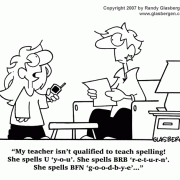
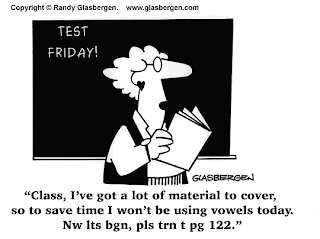
Teenagers make use of abbreviations in an excessive way in text messages and in the Web. Many people fear that students may transfer them to academic writing. Nevertheless, as I pointed out in the previous posting, the use of writing shortcuts is not a phenomenon restricted to teenagers; adults also make use of them. The 2 cartoons that I’m uploading here take a humorous look at the use of abbreviations in schools but this time not as produced by teenage students but teachers.


This picture is a parody of the supposed way in which teenagers write. The humorous effect is achieved by a reversal of expectations. Any person would expect students rather than teachers to spell words this way.


In the second picture, we see exemplified one of the reasons why people use abbreviations: To economize on words and effort. We live in an era where a high value is attached to instantaneity. Thus, shorthand writing is successful because they epitomize immediacy. However, although the use of abbreviations is gaining more and more ground, I am of the opinion that they will never spoil the quality of academic writing. I do believe in the capacity of people to discern between internet slang and language appropriate to the more formal educational setting. If students were to start using abbreviations inadvertently at schools, we can use each of these instances as a "teachable moment", as an opportunity to teach the differences between formal and informal writing. I believe teachers will never let their use become naturalised.

They are humorous, aren’t they? Of course, they are not humorous at all if we believe they are possible snapshots of future classrooms. They are humorous to me because I believe that abbreviations cannot and will not conquer classrooms never ever. To think that either students or teachers may start using them interchangeably in any context is to underestimate the intelligence and the capacity of discernment in the choice of appropriate language in the different situations.

Friday, July 30, 2010

Abbreviations in the Web- also in schools? Part1

Teenagers on social networking sites are creating a new language experts say. Among the many variations that teenager’s language (considered a new chronolect) shows is the excessive use of abbreviations. However, I would like to say that this phenomenon is not restricted to teenagers exclusively since it is possible to find messages written by adults following the same fashion. However, this time I’m going to focus on the use of abbreviations by adolescents.


I’ve heard countless times teachers voicing their concern about the possibility of students transferring the new code they use from the Web to the classroom. They fear this would result in the use of abbreviations in essays for example. As regards this possibility, David Crystal makes a very interesting talk which you can see here .

Whether you can take a look at it or not (I advise you do), I would like to summarize Crystal’s main ideas and comment on them. He states that there are a number of myths surrounding why teenagers make use of abbreviations in text messages and in the Web (For example in Twitter).
People believe that this new text messaging thing and tweeting thing is full of abbreviations introduced by young people for a number of different reasons, which he regards as total myths.

MYTH N° 1: Teenagers are deliberately trying to create a new language so that parents do not understand what they are up to. Crystal counteracts this by saying that only 10 percent of the words found in Tweets and text messages are abbreviations and that 80% of all the people that text message are adults (not teenagers).

MYTH N° 2: Adolescents abbreviate inadvertently because they don’t know how to spell words. Crystal tries to debunk this myth by saying that the reason why teenagers abbreviate is because it’s economic and more efficient or just fashionable or cool.

MYTH N° 3: Abbreviations are the result of a generation that does not longer know how to spell. In order to counteract this new myth, he says that texting is writing and reading on a mobile phone. He adds that although people say that these days children do not read, in fact they are reading in order to text well. To carry out these processes, they need to be quite literate. And since they are literate, they can spell.

MYTH Nº 4: The last myth says that in school, children do not know the difference between how to spell correctly or incorrectly and that they are so careless that they put abbreviations into their exams. Crystal claims that young people are aware of what exactly the difference is between the style of language that has been designed to be used in cell phones or in the Web and that they need to use in their essays.


He concludes by saying that we are still in a mindset where we see the book as central and the electronic technology as marginal while for children this is the other way round. So, one way of managing this would be to put the book into electronic technology. Furthermore, he points that teachers should replace the black and white notion of correct/incorrect language by the recognition and acceptance that there are different styles and that each style has its own purpose. He says that one interesting activity to develop an awareness of appropriacy is to give students an essay and ask them to turn that into a text message or vice versa.


Personally, I totally agree with Crystal’s counterarguments. Though it may be true that some teenagers transfer language appropriate to the Web into academic writings, I think they are the exception rather than the rule. I do believe that teenagers are intelligent enough to differentiate different styles of the language as well as the contexts in which they should use them. In cases where people do use too informal expressions or abbreviations in an academic context, it may be that they have never been taught to draw the appropriate distinction. I think that raising our students’ awareness of the existence of different styles is essential. In my view, schools tend to center their curriculums on the development of formal writing skills that are in most cases too detached from the learners’ daily experience. I do not mean that we should stop teaching how to write a letter because there are circumstances in which we may need to write one and students should be trained to do that. However, I think it vital to include in the curriculum genres which are closer to the adolescents’ experience such as the mail (now included in almost all textbooks) and the text message. Students should learn to compare and contrast the various genres available and make appropriate choices whenever they write.

As regards Crystal's opinion about teenagers’ reading habits at present, he mentions that children do read. I agree with him in that they read different texts (Mind you, it was not easy to get convinced of that). The problem is that we belong to a generation that was for years only in contact with books: they were both sources of knowledge and pleasure as they delighted us with their many stories. It’s being hard to me to accept that nowadays children prefer reading e-mails, postings and comments of any kind rather than classics.

I am convinced that children read (though not the kind of texts I would like them to) and that they are totally capable of showing discernment in the choice of the language they need to use in a particular context. Nevertheless, they may probably need some explicit teaching and training at using the different forms of the language appropriately. And this is a task that we need to tackle in our own classrooms.


Saturday, July 24, 2010

Tied to English


Tied to English

This time I’m writing a personal reflection of how deeply English influences my life… and very probably yours.

Since I’m 7 English is part of my life. I was launched into the world of this new foreign language by my parents who since I was a little girl were already thinking about a not-to distant future that would demand of me some skills at English.

At that time, I enjoyed it but it was just one more activity among those I had. How could I imagine back in those days that English has arrived to stay with me forever? May sound exaggerate for those who do not share (as we do) this passion but this claim is far from blown-up.

Years at the institute in my town, some years more at teacher training college and more entire years to come surrounded by English. I would better say enthralled by its never- ending collection of words and expressions waiting to be learned. It is this passionate interest that drives our minds to be both consciously and unconsciously in search of interesting language data to be acquired. No matter whether we are watching a movie or listening to some song in the radio or surfing the net, we’re always thinking about English, about an interesting new word or expression nice to be learnt or something interesting to be used in some future lesson.

And the story goes on… We come back from our classes at TT College, practicum or our work and our minds can’t simply stop. We keep up thinking how much we enjoyed the class as well as how much our performances still need to be improved. Our minds are thinking about English round-the-clock.

I don’t know whether it’s healthy or not to be thinking about English almost all the time. Perhaps not, who knows? But I do know that this is something we cannot manage, it simply happens. And once we start thinking about the language, our minds can’t stop. English is so rich, so delicious and so full of things we already don’t know (and perhaps will never do) that it simply grabs our attention all the time.
We are language lovers
who will be tied to English forever.